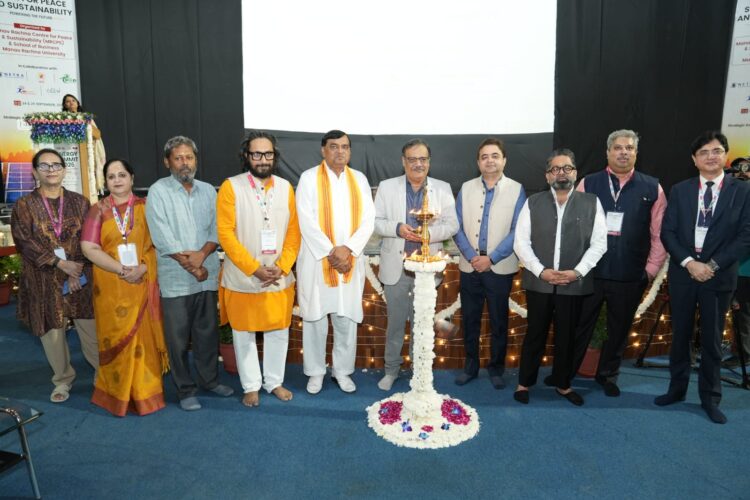
The two-day Energy Summit 2026 – “Solar for Peace & Sustainability: Powering the Future”, organised at Manav Rachna University, Faridabad, brought together leading experts, industry representatives, researchers, academicians, policymakers and young professionals to discuss practical pathways for India’s transition towards clean, reliable, inclusive and sustainable energy.
The Summit opened with an inaugural session exploring the relationship between solar energy, sustainability, energy security and peace. Dr. Amit Bhalla, Prof. (Dr.) Deependra Kumar Jha, Sh. Prafulla Pathak, Sh. Ajay Prakash Shrivastava, Sh. Ashvini Kumar, Dr. Mohammad Rihan, Dr. Rahul Walawalkar and Dr. Anandajit Goswami shared perspectives on India’s expanding solar ecosystem and the challenges of storage, intermittency, grid integration, recycling and domestic manufacturing. Green hydrogen, decentralised solar microgrids, AI-enabled grid management and long-duration energy storage also emerged as important areas for the future.
The session on “Alternative Energy Pathways: Green Hydrogen, Bio Energy & Emerging Clean Technologies” examined the need for diversification of India’s energy mix while balancing affordability, sustainability and energy security. Green hydrogen, nuclear energy, biogas, bio-CNG, biofuels, sustainable aviation fuel, carbon capture, biomass gasification and energy storage were discussed as potential components of India’s evolving energy landscape. Stronger domestic supply chains and industry-academia collaboration were identified as important enablers.
An Industry Leadership Talk by Mr. Vaibhav Chowdhary, Director, ACPET, examined the connection between clean energy, economic development and human well-being. The session highlighted renewable-energy interventions that can create grassroots livelihoods and discussed emerging opportunities in AI, energy analytics, ESG, carbon accounting, recycling, reuse and repurposing. Students and young professionals were encouraged to develop interdisciplinary skills for the emerging clean-energy economy.
Day Two focused strongly on implementation. The session on “Distributed Responsible Energy” examined the complete life cycle of renewable-energy assets, including operation and maintenance, refurbishment, reverse logistics and end-of-life management. Experts emphasised the need for professional service ecosystems and innovative approaches such as Energy-as-a-Service to ensure responsible and efficient management of distributed renewable assets.
A panel on India’s Rooftop Solar Sector examined the sector’s journey from policy ambition to ground-level execution. Quality installation, reliable vendors, financing, warranties, after-sales service, maintenance and consumer awareness were identified as key factors for the next phase of rooftop solar growth. Innovative financing, digital credit assessment, virtual and group net metering and stronger quality standards were also discussed.
The session on “Rural Electrification & Community Solar Models” explored agrivoltaics, solar mini-grids, battery storage, peer-to-peer solar trading and productive applications such as solar irrigation. Speakers stressed that rural electrification must progress beyond basic connectivity towards reliable, quality and economically productive clean-energy access, supported by community ownership and innovative finance.
The “Youth for Sustainable Energy Transition” session positioned young people as active contributors to climate action. Waste-to-energy, biogas, circular economy initiatives and university “living labs” were discussed as practical avenues for youth innovation, with mentoring, incubation and funding identified as important support mechanisms.
The Summit concluded with the “Solar for Peace” declaration in the presence of farmer Arun Kumar recognised by Honorable PM in the Mann Ki Bat, connecting decentralised solar energy with energy security, resilient communities, environmental sustainability and peaceful societies. Wider adoption of rooftop and community solar, affordable storage, stronger grid infrastructure and collaboration among government, academia, industry and civil society were emphasised.
Across the two days, a common message emerged: India’s sustainable energy transition requires more than renewable-energy capacity addition. It demands an ecosystem connecting technology with finance, policy, infrastructure, skills, circularity, communities and human values. Energy Summit 2026 reinforced the vision that powering the future is not simply about generating more energy, but about building energy systems that are reliable, affordable, sustainable, inclusive and capable of contributing to peace, resilience and human well-being from the global south perspective post the BRICS Presidency Declaration of 2026.